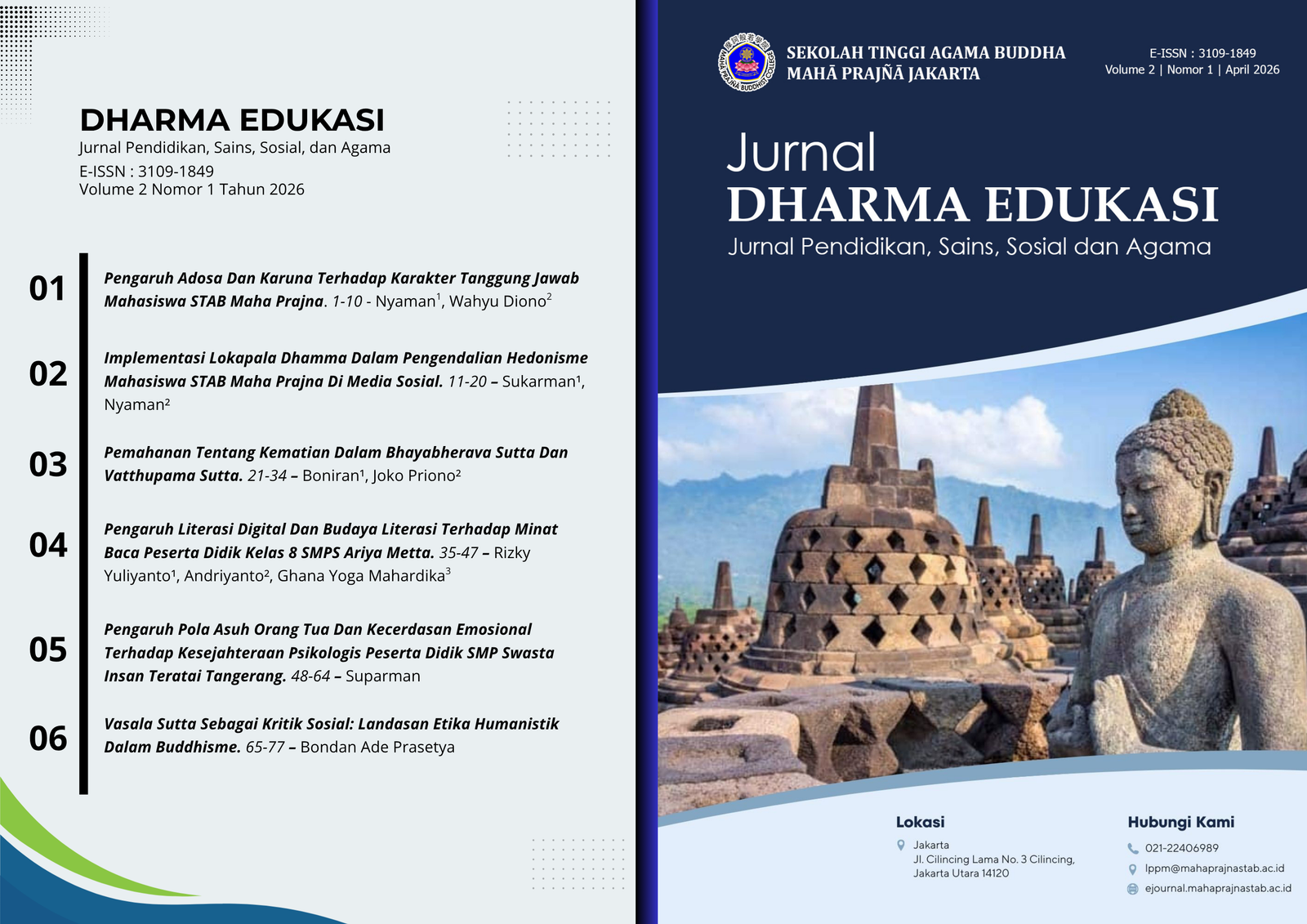
Pengaruh Adosa Dan Karuna Terhadap Karakter Tanggung Jawab Mahasiswa STAB Maha Prajna
DOI:
https://doi.org/10.66791/dharmaed.v2i1.2601Keywords:
Adosa, Karuna, Karakter Tanggung JawabAbstract
The decline of academic integrity in the digital era, reflected in practices such as plagiarism, assignment outsourcing, and weak discipline, highlights the urgent need to strengthen students' sense of responsibility. This study aims to examine the effects of adosa and karuna on the responsibility character of students at STAB Maha Prajna Jakarta. The novelty of this study lies in its empirical investigation of two Buddhist ethical values, adosa and karuna, as predictors of responsibility character within the context of Buddhist higher education, an area that remains underexplored in quantitative research. The study employed a quantitative approach using a survey design involving 60 students. Data were collected through a Likert-scale questionnaire and analyzed using multiple linear regression. The results indicate that adosa and karuna jointly have a significant effect on students' responsibility character (F = 3865.428; p < 0.001), with the model accounting for 99.3% of the variance (R² = 0.993). Partially, both variables were found to have positive and significant effects, with karuna making a more dominant contribution than adosa. These findings suggest that the development of students' responsibility should not rely solely on external discipline, but also on the internalization of self-restraint and compassion as ethical foundations of academic behavior.
Keywords: adosa, karuna, responsibility character, students, Buddhist higher education.
References
Ajaran, Jejak, Sutra, Paramita, Tuo, Talang, Kamahayanikan, Sanghyang, & Paramita, A. Definisi. (2021). Jejak Ajaran. (Roberts 2020), 1–12.
Alberto Ardiansyah, Alberd, Astuti, Dewi, & Dewi, Muditya Ratna. (2025). Tanggung Jawab Sosial serta Kemanusiaan Masyarakat Buddhis. Dharma Acariya Nusantara: Jurnal Pendidikan, Bahasa Dan Budaya, 3(1), 01–10. https://doi.org/10.47861/jdan.v3i1.1498
Devi, Metta Panna. (2022). PELAKSANAAN BRAHMA VIHĀRA SEBAGAI SARANA MEWUJUDKAN TOLERANSI ANTAR UMAT BERAGAMA DI INDONESIA. Jotika Journal in Education, 2(1), 23–28. https://doi.org/10.56445/jje.v2i1.60
Fajrih, Achmad Syahrul, & Maryam, Effy Wardati. (2024). Hubungan Antara Konformitas dengan Perilaku Prososial pada Mahasiswa. Journal of Islamic Psychology, 1(2), 12. https://doi.org/10.47134/islamicpsychology.v1i2.68
Kusuma, Anggita Nurindah. (2022). The state of self-regulated learning and academic dishonesty of undergraduate students during online learning. Psychological Research and Intervention, 5(1), 19–27. https://doi.org/10.21831/pri.v5i1.49441
Lutfiyah, Fikrie, Sabrina, Muhamad, & Jamalie, Zulfa. (2025). Pengaruh Empati Terhadap Perilaku Prososial Pada Mahasiswa Perguruan Tinggi Islam. Jurnal Sikologi, 2(4), 1. Retrieved from https://journal.pubmedia.id/index.php/pjp
Mwakalinga, Shadrack, & Tweve, Chesko. (2026). Assessment of Students ’ Tasks in the Era of Artificial Intelligence : Evidence from Higher Learning Institutions. 2(1), 1–16.
Nesterova, O. Yu. (2021). THREE EDITIONS OF «THE FUNDAMENTAL VALUES OF ACADEMIC INTEGRITY» AS A RESOURCE FOR EDUCATORS. Innovate Pedagogy, (37), 337–340. https://doi.org/10.32843/2663-6085/2021/37.68
Peng, Li, Jiang, Yu, Ye, Jing, & Xiong, Zhiheng. (2024). The Impact of Empathy on Prosocial Behavior Among College Students: The Mediating Role of Moral Identity and the Moderating Role of Sense of Security. Behavioral Sciences, 14(11), 1024. https://doi.org/10.3390/bs14111024
Prasetya, B. A. (2025). Ajaran Agama Buddha Mahayana Dalam Kakawin Kunjarakarna. … Pendidikan, Sains, Sosial Dan Agama …, 1(2), 133–142. https://doi.org/10.66791/18c4mq08
Sbaffi, Laura, & Zhao, Xin. (2022). Evaluating a pedagogical approach to promoting academic integrity in higher education: An online induction program. Frontiers in Psychology, 13. https://doi.org/10.3389/fpsyg.2022.1009305
Sozon, Md, Sia, Bee Chuan, Pok, Wei Fong, & Alkharabsheh, Omar Hamdan Mohammad. (2025). Academic integrity violations in higher education: a systematic literature review from 2013–2023. Journal of Applied Research in Higher Education, 17(5), 1454–1468. https://doi.org/10.1108/JARHE-12-2023-0559
Sukarman, &. Nyaman. (2025). PENGARUH DISIPLIN DIRI PUJA BAKTI DAN DUKUNGAN TEMAN SEBAYA TERHADAP SELF-EFFICACY AKADEMIK. 1(2), 118–132.
Susanti, Salamah Eka. (2022). Konsep Pendidikan Karakter dalam Pemikiran Thomas Lickona “Strategi Pembentukan Karakter yang Baik.” Yasin, 2(5), 719–734. https://doi.org/10.58578/yasin.v2i5.896
Tendhar dan Bueno de Mesquita. (2020). Compassion Education for Prosocial Behavior and Well-Being Among College Students. Compassion Education for Prosocial Behavior and Well-Being Among College Students, 2(2). https://doi.org/10.33790/jmhsb1100115
Valenzuela, Rafael, Codina, Nuria, Castillo, Isabel, & Pestana, José Vicente. (2020). Young University Students’ Academic Self-Regulation Profiles and Their Associated Procrastination: Autonomous Functioning Requires Self-Regulated Operations. Frontiers in Psychology, 11. https://doi.org/10.3389/fpsyg.2020.00354
Yunia, Tjhin Kindella. (2022). Pengantar Etika Psikologis Buddhisme. Humanitas (Jurnal Psikologi), 6(1), 1–28. https://doi.org/10.28932/humanitas.v6i1.3892
Downloads
Published
Issue
Section
License
Copyright (c) 2026 Jurnal Pendidikan, Sains, Sosial dan Agama (Dharma Edukasi)

This work is licensed under a Creative Commons Attribution 4.0 International License.