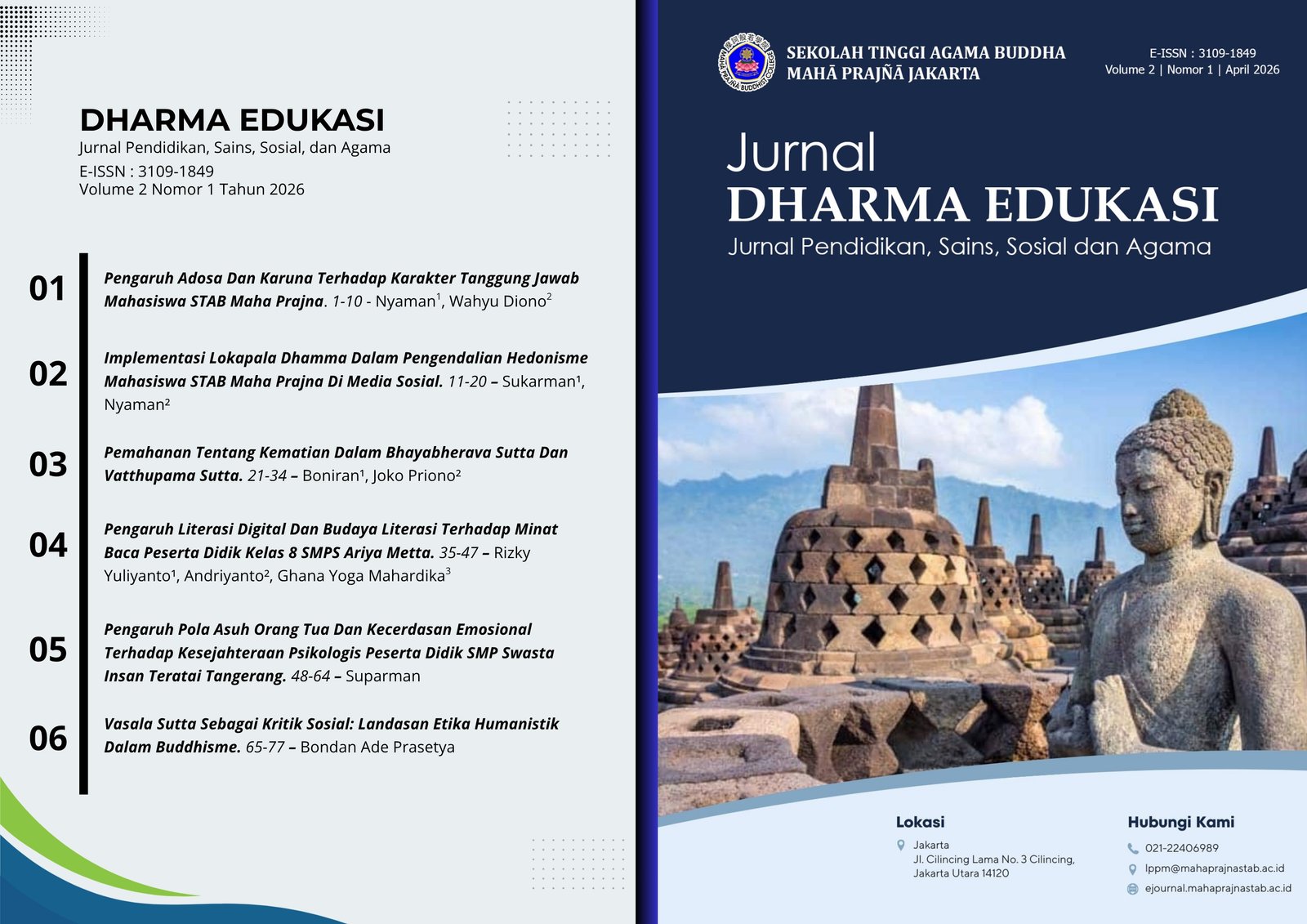
Vasala Sutta Sebagai Kritik Sosial: Landasan Etika Humanistik Dalam Buddhisme
DOI:
https://doi.org/10.66791/dharmaed.v2i1.2606Keywords:
Vasala Sutta, social criticism, humanistic ethics, Buddhism, social discrimination, caste system, moral equality, multicultural societyAbstract
This study aims to analyze the Vasala Sutta as a form of social criticism and to identify the foundations of humanistic ethics within Buddhist teachings that are relevant to the phenomenon of social discrimination based on status and identity. This research employs a descriptive qualitative approach using a library research method, utilizing primary data in the form of the Vasala Sutta text and secondary data derived from indexed scientific journal articles. Data collection techniques are conducted through documentation and systematic literature review, with sources selected using purposive sampling based on relevance and academic credibility. The results indicate several key themes, namely the deconstruction of socially constructed identity based on birth, the affirmation of morality as the primary indicator of human value, criticism of discriminatory social structures, the internalization of humanistic values, and the relevance of these teachings in the context of modern society. These findings demonstrate that the Vasala Sutta embodies principles of moral equality and a critique of the caste system, which can be understood as the foundation of humanistic ethics in Buddhism. In conclusion, this study contributes theoretically to enriching the study of Buddhist ethics through a socio-humanistic perspective, as well as providing practical implications for the development of inclusive values in education and multicultural societies. This study also recommends further research using empirical approaches to explore the implementation of these values in contemporary social contexts.
References
Chairul, Z., & Juniarti, V. (2019). KEADILAN BAGI KELOMPOK MINORITAS DALAM PERSPEKTIF HAK ASASI MANUSIA MENURUT FILSAFAT HUKUM (Contoh Kasus Meliana di Medan Dituduh Melakukan Penodaan Agama). Law Review, 18(2), 227. https://doi.org/10.19166/lr.v18i2.1258
Kumar, S. (2023). Contemporary Applications of Buddhist Idealistic Thought and Ethics: A Critical Assessment. RESEARCH HUB International Multidisciplinary Research Journal, 10(6), 01–05. https://doi.org/10.53573/rhimrj.2023.v10n06.001
Miles, M. B., Huberman, A. M., & Saldaña, J. (2014). Qualitative data analysis: A methods sourcebook. 3rd. Thousand Oaks, CA: Sage.
Ni Made Winda Purwaningsih, Ni Gusti Ayu Agung Nerawati, & Ni Luh Gede Wariati. (2022). ETIKA SOSIAL BUDDHISME DALAM KITAB SUTTA PITAKA (Kajian Filsafat) Ni Made Winda Purwaningsih1, Ni Gusti Ayu Agung Nerawati2, Ni Luh Gede Wariati3. 13(1). https://doi.org/https://doi.org/10.25078
Nowell, L. S., Norris, J. M., White, D. E., & Moules, N. J. (2017). Thematic Analysis: Striving to Meet the Trustworthiness Criteria. International Journal of Qualitative Methods, 16(1). https://doi.org/10.1177/1609406917733847
Phillips, B. (2022). “They’re Not True Humans:” Beliefs about Moral Character Drive Denials of Humanity. Cognitive Science, 46(2). https://doi.org/10.1111/cogs.13089
Saliya, C. A. (2026). Buddhism and Economic Ethics: Perspectives on Theravada, Mahayana, and Modern Applications. In G. J. Buijs & J. J. Ballor (Eds.), In Search of the Spirits of Capitalism: World Religions on Markets & Morality (pp. 179–187). Springer Nature Switzerland. https://doi.org/10.1007/978-3-032-01137-4_9
Setiawan, R., Buana, D. R., & Tanjung, I. P. (2023). The Role of Ethnic Identity in Overcoming Discrimination Against Ethnic Minorities and Politics in Indonesia. SALAM: Jurnal Sosial Dan Budaya Syar-i, 10(4), 1077–1092. https://doi.org/10.15408/sjsbs.v10i4.33985
Snyder, H. (2019). Literature review as a research methodology: An overview and guidelines. Journal of Business Research, 104, 333–339. https://doi.org/https://doi.org/10.1016/j.jbusres.2019.07.039
Somananda, O., & Gohori, J. (2022). New Strategies of Conflict Resolution in Social Work: A Consideration on Buddhist Social Work Approach Based on Sutta Pitaka. Open Journal of Philosophy, 12(02), 199–213. https://doi.org/10.4236/ojpp.2022.122013
Sumaryati, & Lasiyo. (2024). Buddhist Ethical Philosophy in Contemporary Education. RUDN Journal of Philosophy, 28(2), 601–614. https://doi.org/10.22363/2313-2302-2024-28-2-601-614
Thapa, R., van Teijlingen, E., Regmi, P. R., & Heaslip, V. (2021). Caste Exclusion and Health Discrimination in South Asia: A Systematic Review. In Asia-Pacific Journal of Public Health (Vol. 33, Number 8, pp. 828–838). SAGE Publications Inc. https://doi.org/10.1177/10105395211014648
Valle-Lira, M. del C., & Noguera-Solano, R. (2024). Animal Suffering from a Buddhist Perspective: A Reinterpretation of the Four Noble Truths and the Noble Eightfold Path. Journal of Dharma Studies, 7(3), 229–256. https://doi.org/10.1007/s42240-024-00188-7
van Wietmarschen, H. (2025). Moral equality and social hierarchy. Philosophy and Phenomenological Research, 110(1), 97–112. https://doi.org/10.1111/phpr.13093
Yao, F. (2020). The egalitarianism and non-egalitarianism of Buddhist ethics. Asian Philosophy, 30(3), 258–273. https://doi.org/10.1080/09552367.2020.1818443
Yeng, S. (2020). Buddhism, Non-discrimination, and Inclusivity. In S. Yeng (Ed.), Buddhist Feminism: Transforming Anger against Patriarchy (pp. 73–91). Springer International Publishing. https://doi.org/10.1007/978-3-030-51162-3_5
Zed, M. (2008). Metode penelitian kepustakaan. Yayasan Pustaka Obor Indonesia.
Downloads
Published
Issue
Section
License
Copyright (c) 2026 Jurnal Pendidikan, Sains, Sosial dan Agama (Dharma Edukasi)

This work is licensed under a Creative Commons Attribution 4.0 International License.