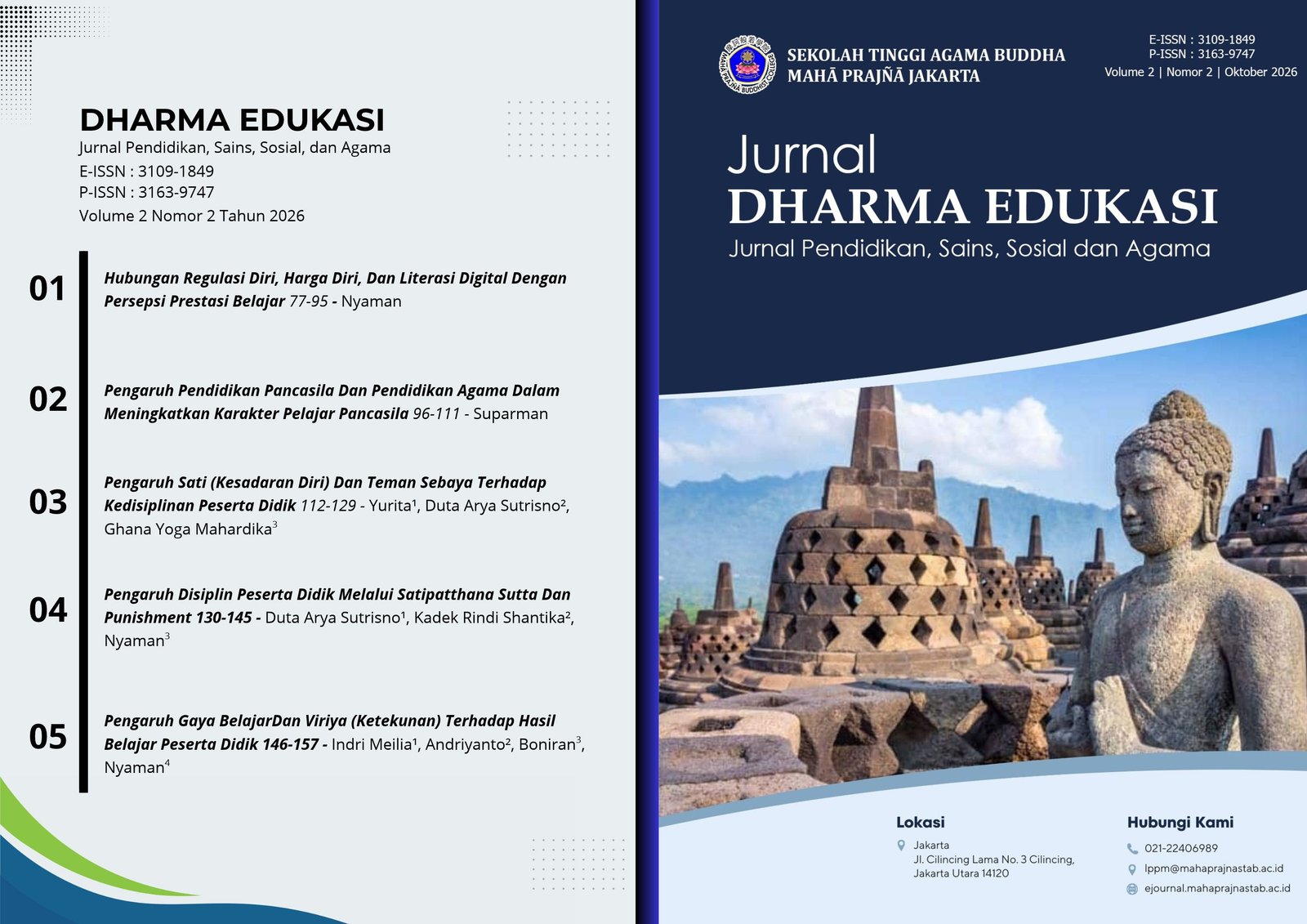
Hubungan Regulasi Diri, Harga Diri, Dan Literasi Digital Dengan Persepsi Prestasi Belajar
DOI:
https://doi.org/10.66791/dharmaed.v2i2.2607Keywords:
self-regulation, self-esteem, Digital Literacy, perceived learning achievementAbstract
This study examined the associations of self-regulation, self-esteem, and digital literacy with students' perceived learning achievement at Ariya Metta Vocational High School, Tangerang. The quantitative ex post facto study included 154 students drawn from a population of 250 through proportional stratified random sampling. Online questionnaire responses were analysed using multiple linear regression in SPSS version 27. Self-regulation (B = 1.349; β = 0.494; t = 6.739; p < .001) and self-esteem (B = 0.624; β = 0.345; t = 4.113; p < .001) were positively associated with perceived achievement after adjustment for the other predictors. Digital literacy showed no significant unique association (B = 0.040; β = 0.019; t = 0.248; p = .804). The model accounted for 63.0% of the observed variation (R² = .630; adjusted R² = .622). Although digital literacy was significant in a simple regression, the association did not persist in the full model, indicating overlapping explanatory information among predictors. The findings support attention to learning management and students' evaluations of themselves while encouraging academically purposeful uses of digital resources. Because achievement was self-reported and the design was observational, the results do not establish causality.
References
Ayadi dan Murdy. (2025). THE EFFECT OF SELF-REGULATED LEARNING AND DIGITAL LITERACY ON STUDENTS’ LEARNING ACHIEVEMENT IN ECONOMICS. JURNAL PENDIDIKAN GLASSER, 9(2), 315–329. https://doi.org/10.32529/glasser.v9i2.4335
Azzahra, S. F. (2025). Academic Achievement and Digital Literacy: A Correlational Study of Student (Prospective Chemistry Teachers) in Universitas Kristen Indonesia. Asian Research Journal of Arts & Social Sciences, 23(8), 322–331. https://doi.org/10.9734/arjass/2025/v23i8770
Bawden, D. (2001). Information and digital literacies: a review of concepts. Journal of Documentation, 57(2), 218–259. https://doi.org/10.1108/EUM0000000007083
Chen, F. (2025). The relationship between digital literacy and college students’ academic achievement: the chain mediating role of learning adaptation and online self-regulated learning. Frontiers in Psychology, 16. https://doi.org/10.3389/fpsyg.2025.1590649
Dianti, T. R., Zulaihati, S., & Swaramarinda, D. R. (2025). THE INFLUENCE OF DIGITAL LITERACY, LEARNING DISCIPLINE, AND SELF-ESTEEM ON THE WORK READINESS. Jurnal Pendidikan Ekonomi, Perkantoran, Dan Akuntansi, 6(1), 65–75. https://doi.org/10.21009/jpepa.0601.06
Dörrenbächer-Ulrich, L., & Bregulla, M. (2024). The Relationship Between Self-Regulated Learning and Executive Functions—a Systematic Review. Educational Psychology Review, 36(3), 95. https://doi.org/10.1007/s10648-024-09932-8
Fong, C. J., Patall, E. A., Snyder, K. E., Hoff, M. A., Jones, S. J., & Zuniga-Ortega, R. E. (2023). Academic underachievement and its motivational and self-regulated learning correlates: A meta-analytic review of 80 years of research. Educational Research Review, 41, 100566. https://doi.org/10.1016/j.edurev.2023.100566
Holm, P. (2025). Impact of digital literacy on academic achievement: Evidence from an online anatomy and physiology course. E-Learning and Digital Media, 22(2), 139–155. https://doi.org/10.1177/20427530241232489
Khasanah, D. N., & Yushita, A. N. (2023). PENGARUH LITERASI DIGITAL, KEMANDIRIAN BELAJAR, DAN PERHATIAN ORANG TUA TERHADAP PRESTASI BELAJAR AKUNTANSI DASAR. Jurnal Pendidikan Akuntansi Indonesia, 21(1), 1–18. https://doi.org/10.21831/jpai.v21i1.44398
Li, F., Cheng, L., Wang, X., Shen, L., Ma, Y., & Islam, A. Y. M. A. (2025). The causal relationship between digital literacy and students’ academic achievement: a meta-analysis. Humanities and Social Sciences Communications, 12(1), 108. https://doi.org/10.1057/s41599-025-04399-6
Luthfiah, A. D., Aisyah, J. N., Fauziah, I. N., & Budiani, M. S. (2025). Strategi self-regulated learning dan kontribusinya pada prestasi akademik siswa sekolah menengah kejuruan. Cognicia, 13(1), 7–15. https://doi.org/10.22219/cognicia.v13i1.38875
Marzano, R. J. (1993). How classroom teachers approach the teaching of thinking. Theory Into Practice, 32(3), 154–160. https://doi.org/10.1080/00405849309543591
Olid‐Luque, M., Ayllón‐Salas, P., Arco‐Tirado, J. L., & Fernández‐Martín, F. D. (2025). Impact of Self‐Regulated Learning Programs in Primary Education: A Systematic Review. Psychology in the Schools, 62(3), 734–755. https://doi.org/10.1002/pits.23352
Pala, Ş. M., & Başıbüyük, A. (2023). The Predictive Effect of Digital Literacy, Self-Control and Motivation on the Academic Achievement in the Science, Technology and Society Learning Area. Technology, Knowledge and Learning. https://doi.org/10.1007/s10758-021-09538-x
Putrie, C. A. R. (2021). Pengaruh Regulasi Diri Siswa Terhadap Prestasi Belajar Siswa Kelas Viii Pada Mata Pelajaran Ips. Research and Development Journal of Education, 7(1), 136. https://doi.org/10.30998/rdje.v7i1.8105
Safhira, N., Sumiati, A., & Faslah, R. (2024). CONTRIBUTION OF SELF-REGULATED LEARNING AND INTEREST IN LEARNING TO THE ACADEMIC SUCCESS OF ARCHIVES MANAGEMENT IN PUBLIC VOCATIONAL SCHOOLS. Jurnal Pendidikan Ekonomi, Perkantoran, Dan Akuntansi, 5(1), 130–142. https://doi.org/10.21009/jpepa.0501.13
Sukarman, & Nyaman. (2026). Pengaruh Disiplin Diri Puja Bakti Dan Dukungan Teman Sebaya Terhadap Self-Efficacy Akademik Mahasiswa STAB Maha Prajna. Jurnal Pendidikan, Sains, Sosial Dan Agama (Dharma Edukasi), 1(2), 118–132. https://doi.org/10.66791/dharmaed.v1i2.2510
Wagner, J., Brandt, N. D., Bien, K., & Bombik, M. (2024). The longitudinal interplay of self-esteem, social relationships, and academic achievement during adolescence: Theoretical notions and bivariate meta-analytic findings. Zeitschrift Für Erziehungswissenschaft, 27(1), 39–61. https://doi.org/10.1007/s11618-023-01177-5
Yudha, D. K., Irawan, I., & Khuntari, D. (2023). Pengaruh Literasi Digital Terhadap Prestasi Belajar Pada Siswa SMP Pusaka Bangsa Karawang. Jurnal Ilmiah Manajemen Informasi Dan Komunikasi, 7(1), 17–28. https://doi.org/10.56873/jimik.v7i1.261
Yuniarti, N., Rahmawati, Y., Anwar, M., Al Hakim, V. G., Hidayat, H., Hariyanto, D., Husna, A. F., & Wang, J. (2024). Augmented reality‐based higher order thinking skills learning media: Enhancing learning performance through self‐regulated learning, digital literacy, and critical thinking skills in vocational teacher education. European Journal of Education, 59(4). https://doi.org/10.1111/ejed.12725
Zahroh dan Dewi. (2022). Hubungan antara self-esteem dengan prestasi belajar siswa di SMA X. Character: Jurnal Penelitian Psikologi,. 167–186.
Zakir, S., Hoque, M. E., Susanto, P., Nisaa, V., Alam, M. K., Khatimah, H., & Mulyani, E. (2025). Digital literacy and academic performance: the mediating roles of digital informal learning, self-efficacy, and students’ digital competence. Frontiers in Education, 10. https://doi.org/10.3389/feduc.2025.1590274
Zhao, Y., Li, Y., Ma, S., Xu, Z., & Zhang, B. (2025). A meta-analysis of the correlation between self-regulated learning strategies and academic performance in online and blended learning environments. Computers & Education, 230, 105279. https://doi.org/10.1016/j.compedu.2025.105279
Downloads
Published
Issue
Section
License
Copyright (c) 2026 Dharma Edukasi (Journal of Education, Science, Social and Religion)

This work is licensed under a Creative Commons Attribution 4.0 International License.