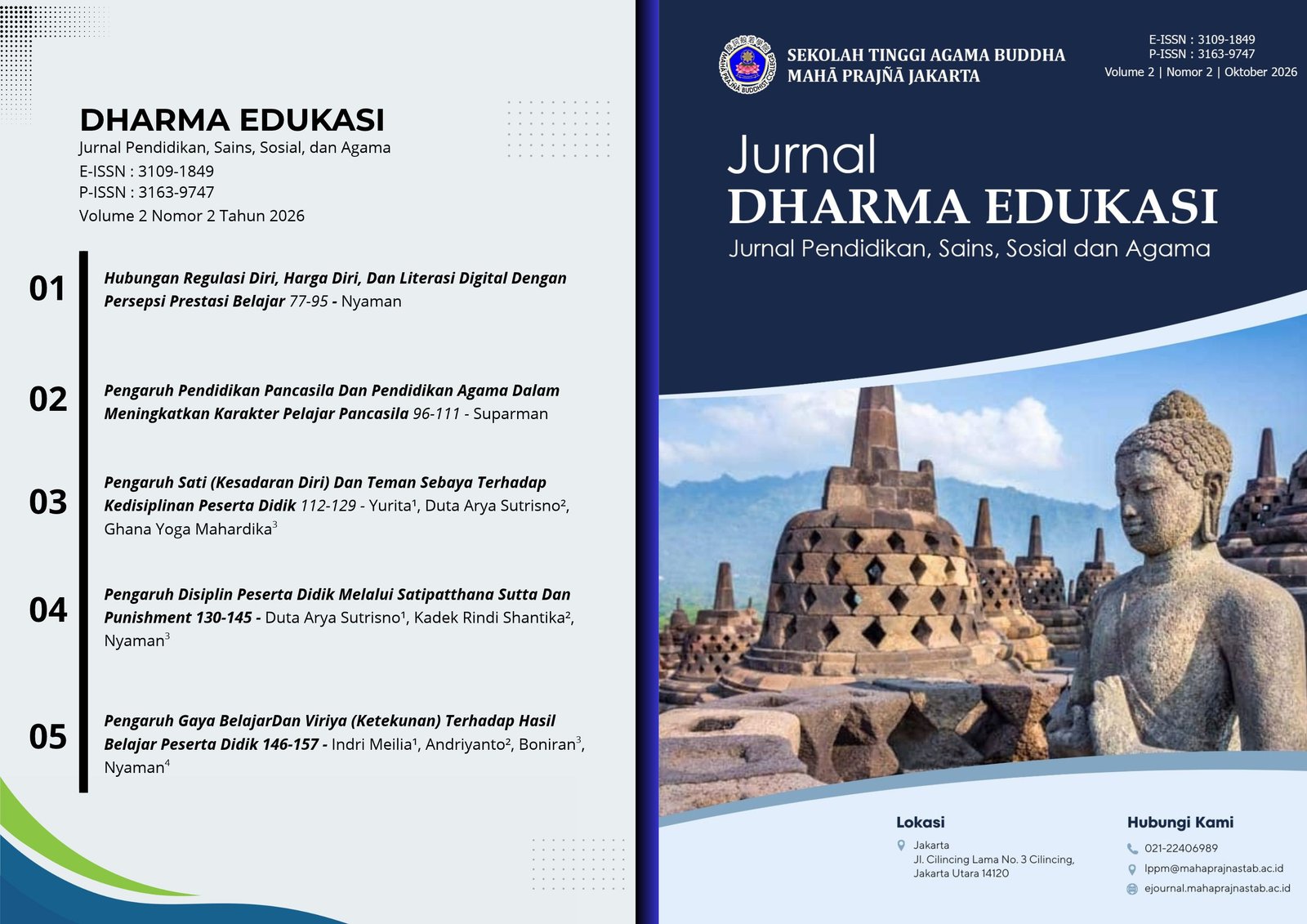
Pengaruh Gaya Belajar Dan Viriya (Ketekunan) Terhadap Hasil Belajar Peserta Didik
DOI:
https://doi.org/10.66791/dharmaed.v2i2.2611Keywords:
learning styles, viriya, perseverance, learning outcomesAbstract
This study was motivated by low learning outcomes in Buddhist Religious Education and Character Building at SMKS Bakti Pangkalpinang: 82.35% of students had not achieved mastery in Semester 1 and 58.82% in Semester 2, presumably related to differing learning styles and low viriya (perseverance). This study analyzed the influence of learning styles and viriya on learning outcomes, partially and simultaneously, using a quantitative ex post facto approach on 58 of 68 students (Slovin formula, purposive sampling). Data were collected via a Likert questionnaire and outcome documentation, analyzed using multiple linear regression (IBM SPSS 25); instruments were valid-reliable and the model met the classical assumption tests. Results: Y = 15.479 + 0.747X1 + 0.297X2. Learning styles (t = 7.510; sig. = 0.000) and viriya (t = 2.993; sig. = 0.004) each had significant positive partial effects, and jointly significant effects (F = 74.112; sig. = 0.000) with an Adjusted R Square of 0.720 (72.0%). Learning styles were the most dominant, contributing 55.14%, underscoring the importance of appropriate learning styles and strengthened viriya.
References
Alwy, M. Y., Herman, Trisnawati, H., Abraham, A., & Rukmana, H. (2024). Analisis regresi linier sederhana dan berganda beserta penerapannya. Jurnal Ilmiah, 6(2), 13331–13344.
Amalia, R., & Wicaksono, A. (2023). Hubungan ketekunan (grit) dengan prestasi belajar peserta didik. Jurnal Bimbingan dan Konseling, 8(1), 45–53.
An, D., Tan, L., & Wang, J. (2024). Metacognition as a mediator between learning readiness and academic achievement: A structural equation modeling approach. Learning and Individual Differences, 110, 102418. https://doi.org/10.1016/j.lindif.2024.102418
Arumsari. (2023). Analisis gaya belajar siswa terhadap hasil belajar pada mata pelajaran IPAS. Learning: Jurnal Inovasi Penelitian Pendidikan dan Pembelajaran, 3(1), 111–119.
Aswanto, F., Yusri, F., & Kurniawan, H. (2024). Analisis gaya belajar VAK (Visual, Auditorial, Kinestetik) siswa di MTsN 4 Pasaman Barat. Dewantara: Jurnal Pendidikan Sosial Humaniora, 3(1), 116–127. https://doi.org/10.30640/dewantara.v3i1.2104
Bodhi, B. (2000). The connected discourses of the Buddha: A translation of the Saṃyutta Nikāya. Wisdom Publications.
Bodhi, B. (2012). The numerical discourses of the Buddha: A translation of the Aṃguttara Nikāya. Wisdom Publications.
Boniran, B. (2017). Perbedaan hasil belajar IPS melalui metode picture and picture dengan complete sentence siswa SDN 1 Blembem Kabupaten Ponorogo. Jurnal Penelitian dan Pendidikan IPS, 11(1), 111–121.
Duckworth, A. L., Peterson, C., Matthews, M. D., & Kelly, D. R. (2007). Grit: Perseverance and passion for long-term goals. Journal of Personality and Social Psychology, 92(6), 1087–1101. https://doi.org/10.1037/0022-
3514.92.6.1087
Duckworth, A. (2016). Grit: The power of passion and perseverance.
Scribner.
Hardiyanti, A., & Ahkam. (2023). Pengaruh grit terhadap prestasi akademik peserta didik. Jurnal Psikologi Pendidikan.
Jumrah, J., Rosidah, R., & Sari, I. P. (2022). Identifikasi gaya belajar VAK (Visual, Auditori, Kinestetik) terhadap hasil belajar peserta didik. Jurnal Inovasi Pendidikan Sains, 13(1), 55–63.
Lubis, H., et al. (2023). The use of learning media and its effect on improving the quality of student learning outcomes. International Journal of Education, Social Studies, and Management (IJESSM), 3(2), 7–14. https://doi.org/10.52121/ijessm.v3i2.148
Lukitasari, M., Hasan, R., & Murtafiah, W. (2022). Faktor-faktor yang mempengaruhi hasil belajar peserta didik: Sebuah kajian literatur. Jurnal Pendidikan dan Kebudayaan, 7(1), 33–46.
Mardiatmoko, G. (2020). Pentingnya uji asumsi klasik pada analisis regresi linier berganda. Jurnal Ilmiah, 14(3), 333–342.
Nafiati, D. A. (2021). Revisi taksonomi Bloom: Kognitif, afektif, dan psikomotorik. Humanika: Kajian Ilmiah Mata Kuliah Umum, 21(2), 151–
174. https://doi.org/10.21831/hum.v21i2.29252
Ñāṃamoli, B., & Bodhi, B. (2005). The middle length discourses of the Buddha: A translation of the Majjhima Nikāya. Wisdom Publications.
OECD. (2023). PISA 2022 results (Volume II). OECD Publishing. https://doi.org/10.1787/a97db61c-en
Siregar, J., Putri, N. R., Sari, T. A., Rahayu, E. T., Mulyana, A., Syarif, F. A., & Farihah, H. (2026). Identifikasi gaya belajar VAK (Visual, Auditori, Kinestetik) siswa SMP Quran Asy Syahid. J-CEKI: Jurnal Cendekia Ilmiah, 5(2), 2288–2291.
Slameto. (2015). Belajar dan faktor-faktor yang mempengaruhinya. Rineka Cipta.
Sugiyono. (2023). Metode penelitian kuantitatif, kualitatif, dan R&D. Alfabeta.
Yandi, A., Nathania, A., Putri, K., & Syaza, Y. (2023). Faktor-faktor yang mempengaruhi hasil belajar peserta didik (Literature review). Jurnal Pendidikan Sosial dan Nilai, 1(1). https://doi.org/10.38035/jpsn.v1i1
Yulianci, S., Nurjumiati, N., & Asriyadin, A. (2020). Analisis karakteristik gaya belajar VAK (Visual, Auditori, Kinestetik) siswa pada pembelajaran fisika. Jurnal Pendidikan MIPA, 10(1), 40–44. https://doi.org/10.37630/jpm.v10i1.328
Downloads
Published
Issue
Section
License
Copyright (c) 2026 Dharma Edukasi (Journal of Education, Science, Social and Religion)

This work is licensed under a Creative Commons Attribution 4.0 International License.